Arnaud Marguin — Osteopath D.O.
Graduate of the Geneva School of Osteopathy (2006)
Registered with the General Osteopathic Council (GOsC) — no. 8938
Member of the Registre des Ostéopathes de France (ROF)
Treatment of lateral epicondylitis with shock wave therapy
Lateral epicondylitis, commonly known as tennis elbow, is a tendinopathy of the wrist extensor muscles at their insertion on the lateral epicondyle of the humerus. Despite its name, it affects people who perform repetitive movements at work (mouse use, manual labour, carrying loads) far more frequently than tennis players.
The pain is located on the outer aspect of the elbow and may radiate towards the forearm. It is aggravated by gripping, hand squeezing, or wrist extension against resistance.
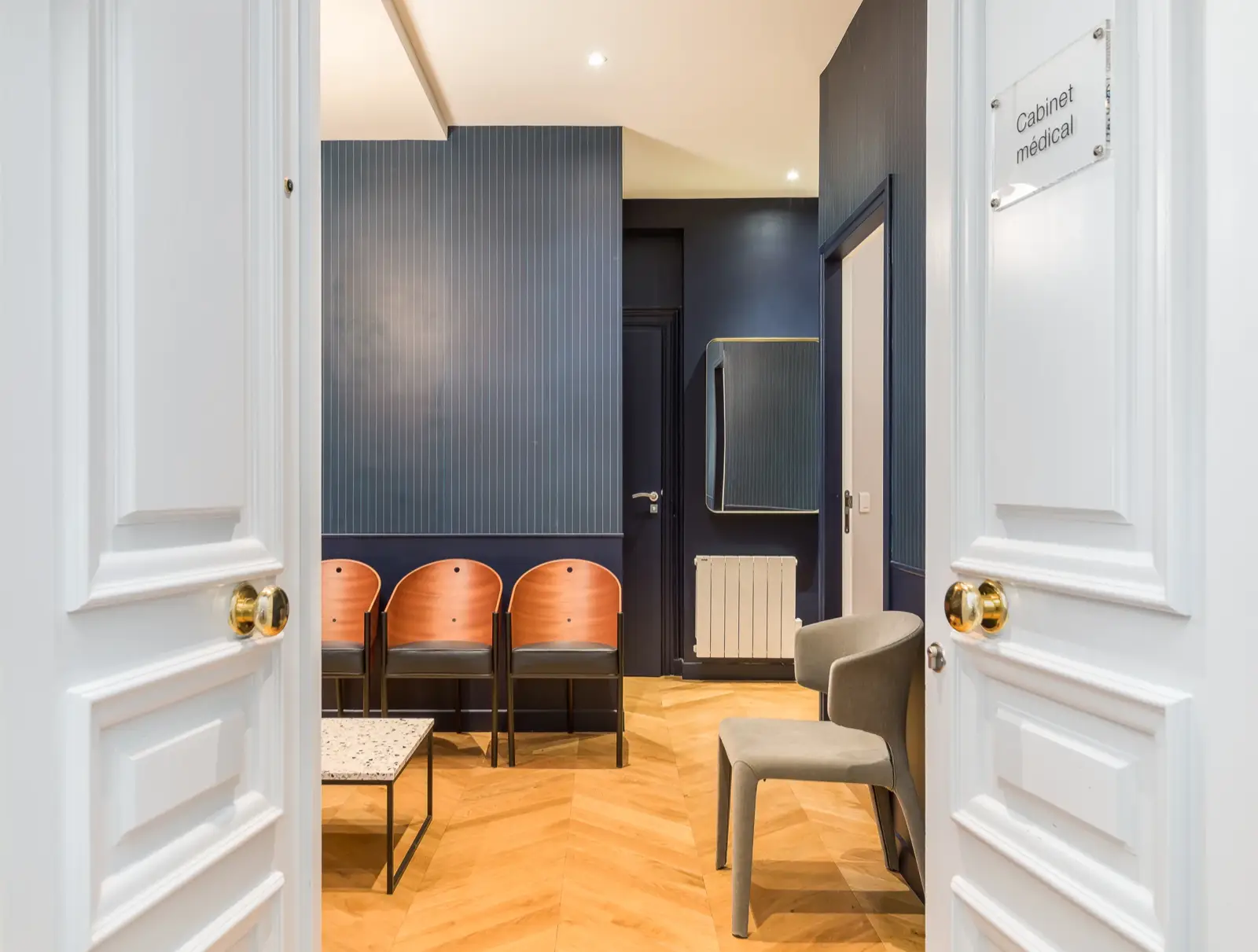
Consultations take place at the clinic located at 9 Rue du Regard, 75006 Paris, in the 6th arrondissement.
Chronic epicondylitis is now considered a degenerative tendinopathy (tendinosis) rather than a classical inflammatory condition. Histological studies show disorganisation of collagen fibres, disordered neovascularisation and an increase in nociceptive nerve endings within the affected tendon.
This degenerative process explains why conventional anti-inflammatory treatments (NSAIDs, corticosteroid injections) often provide only temporary relief. The tendon requires appropriate biological stimulation to restart a healing process.
Radial shock waves act on degenerative tendon tissue through several pathways:
A standard protocol consists of 3 to 5 sessions, spaced 7 to 10 days apart. Each session lasts approximately 5 to 10 minutes. The intensity is gradually adjusted according to the patient's tolerance. The point of maximum tenderness at the epicondyle is targeted by palpation before each session.
Shock wave therapy is considered when epicondylitis has persisted for more than 3 months despite first-line treatments (rest, elbow brace, physiotherapy, ergonomic adaptation).
Epicondylitis is rarely a problem confined to the elbow alone. The osteopathic approach helps identify the biomechanical factors that perpetuate tendon overload:
In addition to treatment, simple adaptations can help reduce the strain on the wrist extensors:
Radial shock wave therapy has shown favourable results in the treatment of chronic lateral epicondylitis, particularly when conservative approaches have been insufficient. Several meta-analyses report significant improvement in pain and function at medium-term follow-up.
The standard protocol consists of 3 to 5 sessions, spaced 7 to 10 days apart. The exact number depends on clinical progress. A reassessment is carried out at each session to adapt the treatment accordingly.
Yes, in most cases. However, it is advisable to modify repetitive movements and prolonged wrist positions during the treatment course. Ergonomic advice is provided during the consultation.
📍 Osteopathy practice
9 Rue du Regard, 75006 Paris
🚇 Metro: Saint-Placide / Rennes / Sèvres-Babylone
A first consultation does not commit you to any treatment plan. We take stock, I examine you, and we decide the next step together.
For a quick slot, calling is the simplest.
Coming from far away? Call before you travel, so we can check together that the trip is worth it.
4.9/5 on Google, 29 reviews · 20 years in practice · GOsC registered (UK)
The information on this page is for informational purposes only.
It does not replace a medical consultation.
Arnaud Marguin — Osteopath D.O.
Graduate of the Geneva School of Osteopathy (2006)
Registered with the General Osteopathic Council (GOsC) — no. 8938
Member of the Registre des Ostéopathes de France (ROF)