Arnaud Marguin — Osteopath D.O.
Graduate of the Geneva School of Osteopathy (2006)
Registered with the General Osteopathic Council (GOsC) — no. 8938
Member of the Registre des Ostéopathes de France (ROF)
Treatment of plantar aponeurosis pain with shock wave therapy
Plantar fasciitis, also known as plantar aponeurosis pain, is a common condition characterised by pain under the heel, particularly during the first steps in the morning or after prolonged periods of rest. It results from strain on the plantar fascia, a band of fibrous tissue connecting the calcaneus to the toes, which plays a fundamental role in supporting the arch of the foot.
A heel spur (calcaneal exostosis) is a calcification that may develop at the insertion of the plantar fascia on the calcaneus. Often discovered incidentally on X-ray, it is a consequence of chronic traction on the enthesis rather than the direct cause of pain in the majority of cases.
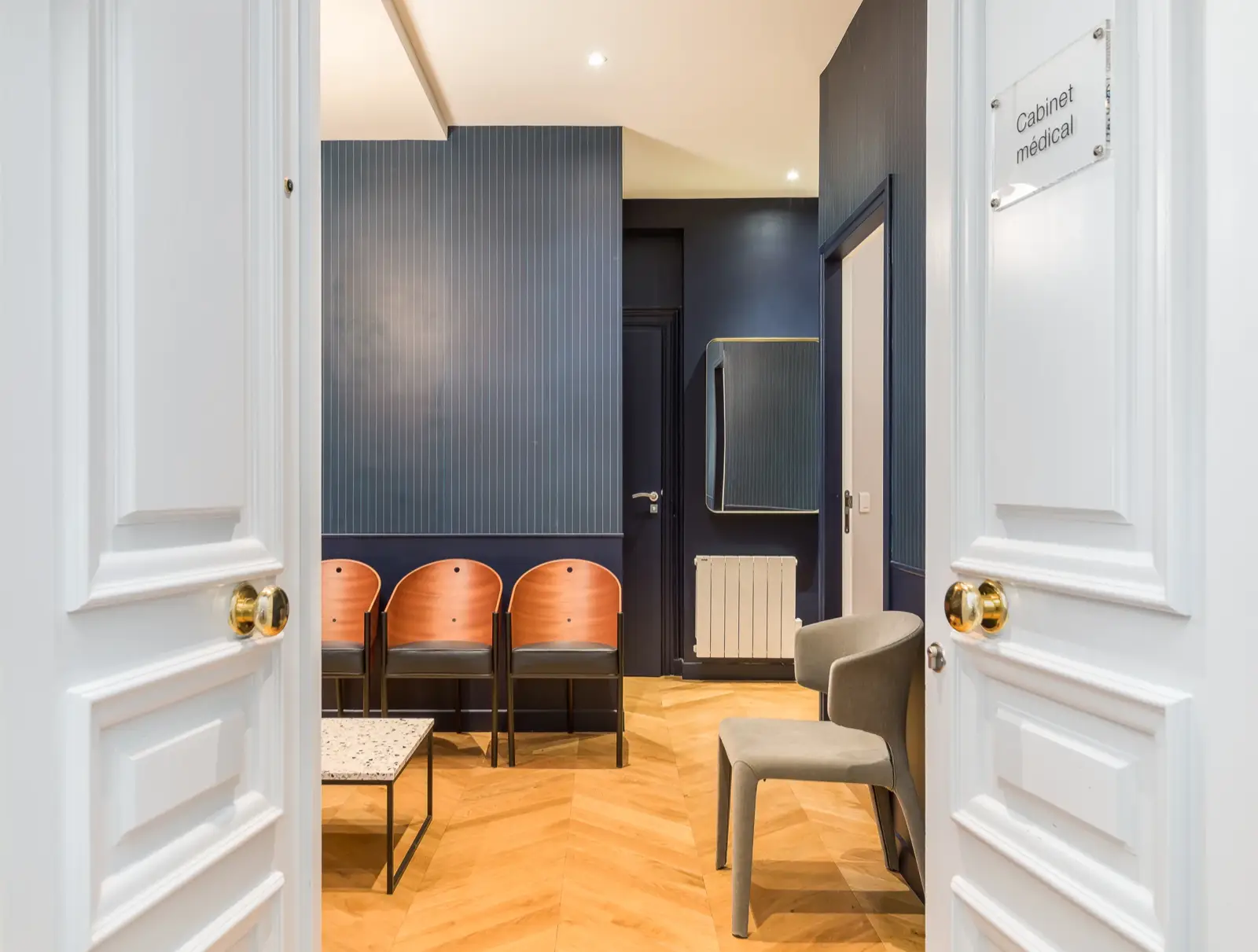
Consultations take place at the clinic located at 9 Rue du Regard, 75006 Paris, in the 6th arrondissement.
The plantar fascia is a poorly vascularised tissue, particularly at its calcaneal insertion. When the mechanical load exceeds the tissue's capacity to adapt, a degenerative process gradually develops: this is more accurately described as plantar fasciopathy rather than acute inflammation. This impaired healing response explains why some cases of plantar fasciitis resist conventional conservative treatments (rest, orthotic insoles, stretching) and persist beyond 3 months.
Radial shock waves act on fascial tissue through several complementary mechanisms:
The protocol generally consists of 3 to 5 sessions, spaced 5 to 10 days apart. Each session lasts approximately 5 to 10 minutes for the treated area. The intensity is gradually adjusted according to the patient's tolerance.
Shock wave therapy is indicated when conservative treatment (relative rest, calf and plantar fascia stretching, orthotic insoles) has not provided satisfactory improvement after a minimum of 3 months. This duration criterion is important to ensure that first-line approaches have been properly followed before considering shock wave therapy.
At each session, the point of maximum tenderness is located by palpation. A coupling gel is applied to the area, and the applicator delivers the acoustic waves. The sensation is that of a rapid, repeated percussion of adjustable intensity. Most patients describe moderate discomfort that remains tolerable. After the session, local tenderness may persist for a few hours. Walking is possible immediately.
Plantar fasciitis is rarely an isolated problem of the foot. The osteopathic approach allows identification and treatment of the biomechanical factors contributing to overload of the plantar fascia:
Combining shock wave therapy (targeted action on the injured tissue) with osteopathic treatment (correction of contributing biomechanical factors) provides a more comprehensive approach and aims to reduce the risk of recurrence.
Several randomised controlled trials have shown that radial shock wave therapy is an effective treatment for chronic plantar fasciitis, particularly when conservative approaches have failed to provide satisfactory results after 3 months. The favourable response rate is generally above 60% in the published literature.
The standard protocol consists of 3 to 5 sessions, spaced 5 to 10 days apart. The exact number is adjusted based on clinical progress. Some improvement may be felt after the first sessions, but the full benefit often develops in the weeks following completion of the treatment course.
Yes, walking is possible immediately after the session. Some local tenderness may persist for a few hours. It is advisable to limit intense sporting activities for 24 to 48 hours after each session.
📍 Osteopathy practice
9 Rue du Regard, 75006 Paris
🚇 Metro: Saint-Placide / Rennes / Sèvres-Babylone
A first consultation does not commit you to any treatment plan. We take stock, I examine you, and we decide the next step together.
For a quick slot, calling is the simplest.
Coming from far away? Call before you travel, so we can check together that the trip is worth it.
4.9/5 on Google, 29 reviews · 20 years in practice · GOsC registered (UK)
The information on this page is for informational purposes only.
It does not replace a medical consultation.
Arnaud Marguin — Osteopath D.O.
Graduate of the Geneva School of Osteopathy (2006)
Registered with the General Osteopathic Council (GOsC) — no. 8938
Member of the Registre des Ostéopathes de France (ROF)