Arnaud Marguin — Osteopath D.O.
Graduate of the Geneva School of Osteopathy (2006)
Registered with the General Osteopathic Council (GOsC) — no. 8938
Member of the Registre des Ostéopathes de France (ROF)
Nerve compression relief
Sciatica is a pain that radiates along the sciatic nerve, from the lower back or buttock region down to the lower limb. It most commonly results from compression or irritation of a nerve root at the level of the lumbar spine.
Neurovertebral spinal decompression is a non-surgical approach that may be considered when sciatica is of discogenic origin, that is when it is related to a protrusion or herniation of the intervertebral disc.
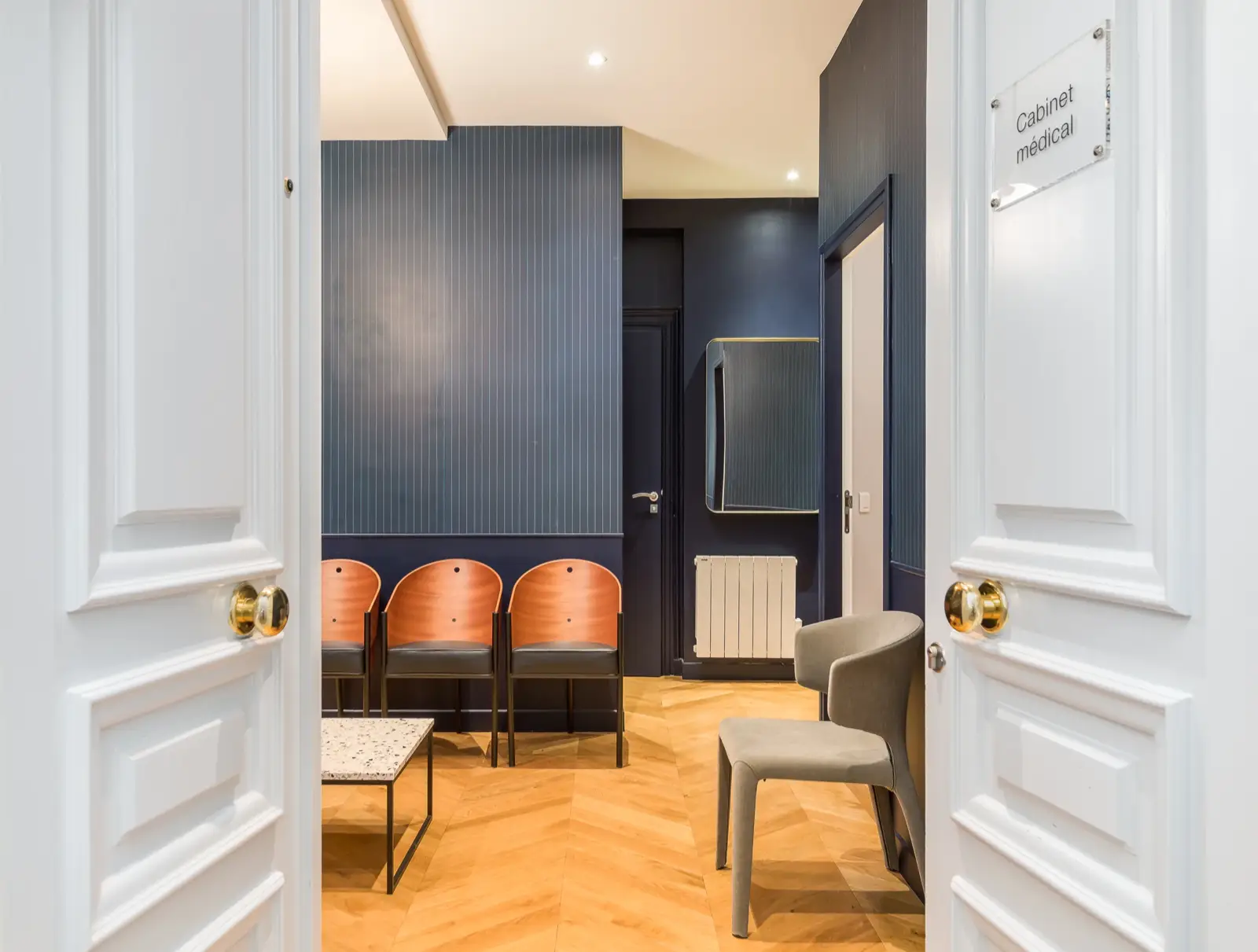
Consultations take place at the practice located at 9 Rue du Regard, 75006 Paris, in the 6th arrondissement.
Not all forms of sciatica are the same. Identifying the origin of the pain is essential for guiding the appropriate management:
This is the most common form. A herniation or disc protrusion at the L4-L5 or L5-S1 level directly compresses the nerve root. The pain follows a specific path and may be accompanied by tingling, numbness or muscle weakness. This is the situation in which neurovertebral spinal decompression is most indicated.
The piriformis muscle, located in the buttock, can compress the sciatic nerve along its course. The pain is similar but the origin is not discogenic. In this case, spinal decompression is not indicated: targeted manual treatment of the piriformis and gluteal muscles is more appropriate.
Facet joint osteoarthritis or narrowing of the intervertebral foramen can irritate the nerve root without disc involvement. Decompression may be discussed on a case-by-case basis depending on the clinical context.
When sciatica is of discogenic origin, spinal decompression works by creating negative intradiscal pressure at the level of the affected segment. This mechanism aims to:
The traction is applied progressively and cyclically, with parameters adapted to the exact location of the compression (L4-L5, L5-S1) and to the patient's tolerance.
Neurovertebral spinal decompression may be considered in the following situations:
It is not suitable in cases of:
The protocol is tailored to each patient:
Title: Effects of non-surgical spinal decompression as an adjunct to physiotherapy in patients with lumbar radiculopathy.
Method: Randomised trial comparing physiotherapy alone versus physiotherapy plus 12 decompression sessions over 4 weeks.
Results:
Reference: PubMed
Title: Influences of spinal decompression therapy and general traction therapy on the pain, disability, and straight leg raising of patients with intervertebral disc herniation.
Method: 30 patients split into two groups of 15 — spinal decompression table or lumbar traction table — three sessions a week for four weeks, both with conservative physiotherapy. Measures: VAS, ODI, straight-leg-raise angle.
Results:
Reference: PubMed
📍 Osteopathy practice
9 Rue du Regard, 75006 Paris
🚇 Metro: Saint-Placide / Rennes / Sèvres-Babylone
A first consultation does not commit you to any treatment plan. We take stock, I examine you, and we decide the next step together.
For a quick slot, calling is the simplest.
Coming from far away? Call before you travel, so we can check together that the trip is worth it.
4.9/5 on Google, 29 reviews · 20 years in practice · GOsC registered (UK)
The information on this page is for informational purposes only.
It does not replace a medical consultation.
Arnaud Marguin — Osteopath D.O.
Graduate of the Geneva School of Osteopathy (2006)
Registered with the General Osteopathic Council (GOsC) — no. 8938
Member of the Registre des Ostéopathes de France (ROF)