Arnaud Marguin — Osteopath D.O.
Graduate of the Geneva School of Osteopathy (2006)
Registered with the General Osteopathic Council (GOsC) — no. 8938
Member of the Registre des Ostéopathes de France (ROF)
Neurovertebral spinal decompression
This page answers the most frequently asked questions from patients about neurovertebral spinal decompression. If your question is not covered here, please do not hesitate to contact us directly.
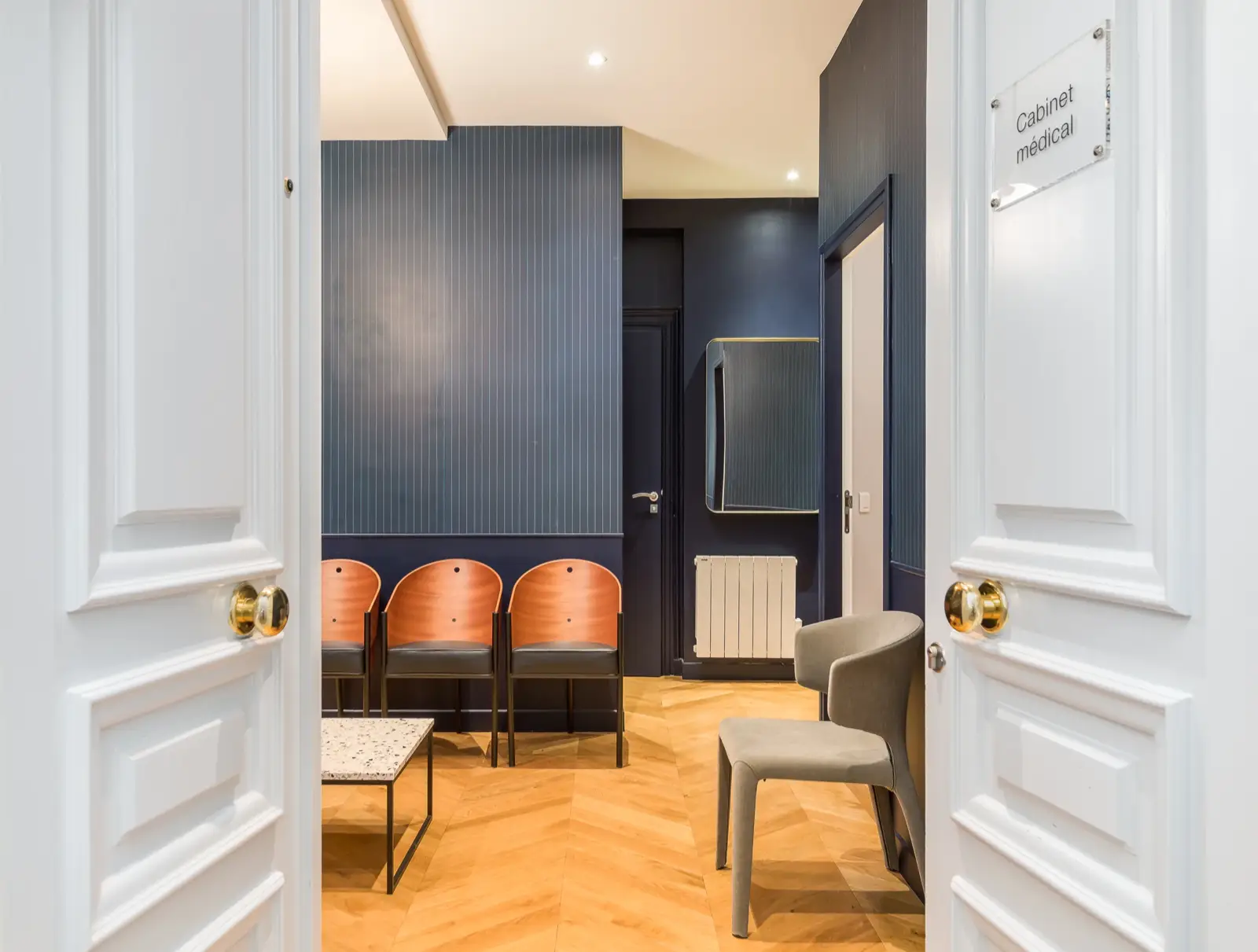
The practice is located at 9 Rue du Regard, 75006 Paris, in the 6th arrondissement.
Neurovertebral spinal decompression is generally not painful. The traction is progressive and controlled, with parameters adapted to each patient's tolerance. Most patients experience a pleasant stretching sensation during the session. If any discomfort occurs, the settings are immediately adjusted. Some patients report relief from the very first sessions.
Usually 10 to 15 sessions, spread over three to four months. The pace is deliberately measured: one or two sessions a week at the start, never more, then we space them out as the pain recedes, one session every one to two weeks, then every two to four. We take stock around the fifth or sixth session to decide what comes next. The final number depends on what is being treated, how long it has been there, and how your back responds.
Neurovertebral spinal decompression is performed as part of an osteopathy consultation at a fee of 100 euros. Osteopathy is not covered by the French national health insurance (Securite sociale). However, many supplementary health insurance plans (mutuelles) offer an annual allowance covering 1 to 5 osteopathy sessions. The amount reimbursed varies from 25 to 100 euros per session depending on the contract. It is advisable to check your supplementary health insurance contract and request an invoice after each consultation.
Conventional traction applies a constant, linear force to the spine without precise segmental targeting. Neurovertebral spinal decompression uses a cyclical protocol with alternating phases of traction and release, at angles and forces specifically calculated to target a given spinal segment. This cyclical approach aims to bypass the reflex muscle contraction (myotatic reflex) and optimise the mechanical effect on the intervertebral disc by creating negative intradiscal pressure.
The main contraindications are:
A thorough clinical examination is performed before every session to exclude these contraindications.
Results vary between patients and depend on the condition being treated. Published clinical studies report improvement in pain and function in the majority of patients treated for disc herniation or radiculopathy. Improvement generally affects radicular pain first (sciatica, cruralgia), followed by local pain (lumbar or cervical) and functional mobility. Results are not guaranteed and depend on many individual factors: herniation size, duration of symptoms, general condition and adherence to the protocol.
It is generally advisable to maintain moderate physical activity during the protocol, whilst avoiding movements that aggravate symptoms. Well-tolerated activities include:
It is recommended to temporarily avoid:
Personalised advice is given at each session according to progress.
An MRI is not systematically required to begin treatment. The clinical examination often allows the diagnosis to be established and the indication for decompression to be determined. However, an MRI is recommended in the following situations:
The MRI allows precise visualisation of the disc herniation, assessment of its impact on the nerve structures and confirmation of the decompression indication.
The decompression session is integrated into an osteopathy consultation lasting approximately 45 minutes. The traction phase itself lasts between 15 and 25 minutes, with cycles of traction and release. The remaining time is dedicated to the clinical examination, complementary osteopathic treatment (addressing muscular tension, joint mobility) and personalised advice.
Decompression may be considered for elderly patients, subject to a thorough clinical assessment. The traction forces are adapted to the patient's bone and joint condition. Severe osteoporosis, spinal instability and certain advanced degenerative conditions are contraindications. In the absence of contraindications, decompression is generally well tolerated and can help relieve disc-related pain in patients of any age.
Neurovertebral spinal decompression is a conservative approach that can be offered before considering surgery, when the indication is appropriate. In some cases, it achieves sufficient improvement to avoid an operation. However, surgery remains necessary in the following situations:
The goal is always to offer the most appropriate treatment for each situation, in collaboration with physicians and surgeons when necessary.
📍 Osteopathy practice
9 Rue du Regard, 75006 Paris
🚇 Metro: Saint-Placide / Rennes / Sèvres-Babylone
A first consultation does not commit you to any treatment plan. We take stock, I examine you, and we decide the next step together.
For a quick slot, calling is the simplest.
Coming from far away? Call before you travel, so we can check together that the trip is worth it.
4.9/5 on Google, 29 reviews · 20 years in practice · GOsC registered (UK)
The information on this page is for informational purposes only.
It does not replace a medical consultation.
Arnaud Marguin — Osteopath D.O.
Graduate of the Geneva School of Osteopathy (2006)
Registered with the General Osteopathic Council (GOsC) — no. 8938
Member of the Registre des Ostéopathes de France (ROF)